Pressure on nerve roots L1-L3 are often associated with pain above the knee. Also one may have decreased sensation in the anterior thigh.
The pressure and radiculopathy most commonly affects the L4, L5, and S1 nerve root levels.
Someone with pressure at the L4 level most often have weakness in the quadriceps muscle, pain in the low back and or front of the leg, and a decreased knee (patellar) reflex.
An individual with L5 symptomatology often has pain in the low back and or pain on the side of the leg, as well as a decreased medial hamstring reflex, weakness of the antherior lower leg muscles, and sometimes sensory loss on the outer calf.
S1 radiculopathy often creates pain in the low back, and or pain down the back of the leg or pain in the foot. The Achilles reflex may also be affected as well as sensation on the lateral foot and calf muscle strength.
Symptoms other than pain may include numbness and tingling, or burning pain. Also, most symptoms usually occur on one side of the body as the left nerve roots exit the spine on the left side of the low back and the right nerve roots exit on the right side. Sometimes pressure can be more central creating irritation to both nerve roots. This will often give bilateral symptoms.
One must keep in mind that depending on which nerve fibers have pressure on them and how severe that pressure is often determines your symptoms. If symptoms persist or get worse, see a professional right away.
If you have specific questions about a lumbar radiculopathy or sciatica or have tried various treatments with no real success, call our office at 860-633-8756 to find out if we may be able to help.
Additional Reading Resources:
Tuesday, April 28, 2009


Sunday, April 26, 2009
Low Back And Leg Pain Relief...
Treatments Available For Your Sciatica!

The 1st line of defense is usually conservative treatment by your doctor, chiropractor, or therapist.
Your doctor may use some anti-inflammatory or pain relief meds or over the counter medication. He may also give you some home exercises or stretches to perform that help the muscles.
Your chiropractor will use gentle spinal manipulations to align the spine as well as muscular therapies like electrical muscle stimulation, ultrasound, ice, or heat, trigger point work to name a handful.
Your medical doctor or your chiropractor will also use specific test in the office to best determine the cause of your symptoms; they may also send you for specific images such as an MRI, or CT scan of your spine and discs.
Your physical therapist may work with on stretching, strengthening muscles, as well as postural exercises and other therapies.
Your massage therapist will use various muscle techniques to relief muscle tension, spasm, and trigger points.
If this does not work the new treatment method of choice is non-surgical spinal decompression with the drx9000.
Pain relief shots are another treatment option. This is typically in the form of a steroid injection or an epidural.
If all of these options fail the next alternative is surgery. There are many types of back surgery. Keep in mind no matter how non-invasive you think this or that surgery may be, it’s still surgery. Any good doctor or surgeon will only recommend this if the individual has exhausted all other options and/or have such severe symptoms it warrants immediate action.
CT Spine and Disc Center is located in central Connecticut- Specializing in patients who suffer from sciatica, disc degeneration, bulging disc or herniated disc in the lumbar spine. Call us at 860-633-8756 to see if you are a candidate for non surgical spinal decompression
Additional Reading Resources:
Sunday, April 19, 2009
What is Causing My Sciatica??
Sciatica or a lumbar radiculapathy is when pressure is put on one or more of your lumbar nerve roots. The nerve roots in the lower lumbars form together to make the sciatic nerve which travels down the leg. It gives off numerous branches that go to various parts of the leg – your toes, muscles, blood vessels, etc. Hence the term sciatica. It’s the general term for pain going from the lower body down the leg.
So what’s causing the pressure? The main pressure is from inflammation in the area. This is usually caused by a disc injury, trauma, facet irritation, arthritic changes, or stenosis. A disc bulge for example may put pressure on a nerve inflamming the nerve, causing pain or another symptom. The facet joints, which are the joints that exist just behind where the nerve roots exit off the spinal cord, can get irritated from a disc bulge can create inflammation which closes in on the nerve root.
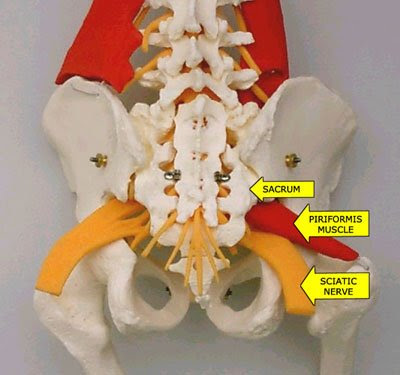
In fact many things can cause irritation and inflammation in the low back. This is why so many people have experienced a severe episode or two of back pain. Even a severe strain or muscle spasm can create significant pain. A irritation to muscles in the low back or buttocks can cause radiculopathy or sciatica. Remember the nerve roots exit out of hole called foramen and form together into the sciatic nerve. Therefore spasm, muscle inflammation and strain of one or more of the muscles located in this region can cause problems. Also, the sciatic nerve, before it travel down the leg, goes through two heads of the piriformis muscle which is located in the buttocks.
Another common cause of pain is a spinal misalignment. A trauma to the low back, maybe a car accident or a fall, or a sports injury can cause a shift of the spine. Muscle spasm, poor posture, and heavy lifting are a few other causes of misalignments or subluxations.
Someone can even have a specific misalignment called a spondylolesthesis which is a shift of vertebrae forward or backwards on the one below it. This is often more severe and can be from a trauma but also one may be born with it or it happens because of severe lumbar degeneration.
These are the many causes of your back and leg pain. The next blog post I’ll cover treatment options for individuals currently suffering from lumbar radiculopathy.
If you have specific questions about a lumbar radiculopathy or sciatica or have tried various treatments with no real success, call our Glastonbury CT office at 860-633-8756 to find out if we may be able to help.
CT Spine and Disc Center is located in central Connecticut- Specializing in patients who suffer from sciatica, disc degeneration, bulging disc or herniated disc in the lumbar spine. Call us at 860-633-8756 to see if you are a candidate for non surgical spinal decompression
Additional Reading Resources:
So what’s causing the pressure? The main pressure is from inflammation in the area. This is usually caused by a disc injury, trauma, facet irritation, arthritic changes, or stenosis. A disc bulge for example may put pressure on a nerve inflamming the nerve, causing pain or another symptom. The facet joints, which are the joints that exist just behind where the nerve roots exit off the spinal cord, can get irritated from a disc bulge can create inflammation which closes in on the nerve root.

In fact many things can cause irritation and inflammation in the low back. This is why so many people have experienced a severe episode or two of back pain. Even a severe strain or muscle spasm can create significant pain. A irritation to muscles in the low back or buttocks can cause radiculopathy or sciatica. Remember the nerve roots exit out of hole called foramen and form together into the sciatic nerve. Therefore spasm, muscle inflammation and strain of one or more of the muscles located in this region can cause problems. Also, the sciatic nerve, before it travel down the leg, goes through two heads of the piriformis muscle which is located in the buttocks.
Another common cause of pain is a spinal misalignment. A trauma to the low back, maybe a car accident or a fall, or a sports injury can cause a shift of the spine. Muscle spasm, poor posture, and heavy lifting are a few other causes of misalignments or subluxations.
Someone can even have a specific misalignment called a spondylolesthesis which is a shift of vertebrae forward or backwards on the one below it. This is often more severe and can be from a trauma but also one may be born with it or it happens because of severe lumbar degeneration.
These are the many causes of your back and leg pain. The next blog post I’ll cover treatment options for individuals currently suffering from lumbar radiculopathy.
If you have specific questions about a lumbar radiculopathy or sciatica or have tried various treatments with no real success, call our Glastonbury CT office at 860-633-8756 to find out if we may be able to help.
CT Spine and Disc Center is located in central Connecticut- Specializing in patients who suffer from sciatica, disc degeneration, bulging disc or herniated disc in the lumbar spine. Call us at 860-633-8756 to see if you are a candidate for non surgical spinal decompression
Additional Reading Resources:
- How does spinal decompression work ?
- How does Drx9000 spinal decompression work?
- Is your Lower Back Pain or Leg Pain the result of a radiculopathy?
- Learn how chiropractic manipulation can be extremely valuable on your pathway to health and relief of pain
- Understanding Non Surgical Spinal Decompression: FAQ's
- Research about Non Surgical Spinal Decompression
Saturday, April 18, 2009
Is Your Lower Back Pain Or Leg Pain The Result Of A Lumbar Radiculopathy?
 Severe Lower Back Pain Or Leg Pain may be the Result Of A Lumbar Radiculopathy. Patients who present with lower back pain that is radiating into their legs and feet may be diagnosed with a lumbar radiculopathy. A lumbar radiculopathy includes anything that causes irritation, compression or dysfunction of one or more of the lumbar (low back) nerves. The lumbar nerve roots are sensitive to any type of irritation or pressure- and can cause those nerve roots to not function properly. The general term we often use for a lumbar radiculopathy is Sciatica.
What goes on at the nerve root level in the low back can cause many different symptoms? Any type of irritation to the nerve root can cause inflammation which can then cause back pain. Believe it or not, pressing on a nerve may not cause pain, or at least pain right away, but it will cause neurological deficits at some level.
The lumbar nerve roots have sensory, motor, and reflex components. When we say compression of a nerve root could cause neurological deficits, the sensory, motor or reflex component may be affected. Each nerve in the low back controls certain muscles and certain sensations and reflexes in areas of the low back, buttocks and legs.
Radiculopathy can be caused by different things- and often times it is important to distinguish a radiculopathy from other conditions such as spinal cord lesion or a severe muscle strain.
To diagnose a radiculopathy, it is important to have a proper history and consultation with your Doctor. What caused this pain? What is the pain level? Does the back pain travel into the legs? Does the pain cause numbness and tingling anywhere? Your doctor will determine what level the radiculopathy is taking place by looking at sensory changes such as feeling altered sensations or tingling, decreased or absent reflexes, and weakness in certain muscles. This goes back to looking at the sensory, motor and reflex aspect of each lumbar nerve root. So the first step in understanding a lumbar radiculopathy, is to see your doctor for a proper consultation, history and examination. You may also be sent out for specific imaging studies such as a lumbar MRI.
I will discuss more about specific details about what can cause a radiculopathy, what symptoms present at certain levels and how to treat this type of back pain or sciatica in the next couple blog posts. If you have specific questions about a lumbar radiculopathy or sciatica or have tried various treatments with no real success, call our office at 860-633-8756 to find out if we may be able to help.
CT Spine and Disc Center is located in central Connecticut- Specializing in patients who suffer from sciatica, disc degeneration, bulging disc or herniated disc in the lumbar spine. Call us at 860-633-8756 to see if you are a candidate for non surgical spinal decompression
Additional Resources:
Monday, April 6, 2009
Does The Use Of A Low Back Support Or Lower Back Brace Really Make A Difference?

“Do you think a back brace will help my condition?” This is a frequently asked question in my Glastonbury office by patients who suffer from lower back pain. The answers typically vary, as there is support for and against the use of a brace when low back pain is present.
In a recent Spine study in February 2009, the use of an elastic lumbar belt was studied in a group of subacute low back pain patients for its effect on functional capacity (lift and carry types of activities), pain intensity, and the effects on health care service costs. This study was unique in that it was carried out in several different locations and, the patients were randomized and received either a lumbar belt or nothing (“control group”). 197 patients were included in the study, which is a good sample size for research purposes. The results of the study, at the end of 90 days, revealed a higher score for the back brace treated group than the non-braced control group. The pain scale improved greater in the brace treated group as an improvement of 42 points vs. 32 points was reported. Similarly, 61% in the brace treated group used no medication compared to 40% in the non-braced group. It was concluded that patients with subacute low back pain improved significantly in functional status, pain reduction and medication utilization.
The use of back braces has been considered a “standard” in the treatment of patients with Low back pain for many years. One argument against using back braces centers around becoming “dependant” either physically or mentally on its use and this has long been a concern amongst health care providers. For most patients, this is not a concern as most do not “enjoy” the use of a brace and they look forward to discontinuing their use of it. Braces are particularly helpful when the patient cannot stop performing needed activities, such as work. This is especially true for farmers who have to tend to the animals and crops during planting, cultivating and harvest times of the year. In addition, single moms or dads who have to go to work in order to provide for their children are driven to stay on the job. In these cases, the use of a back brace can be of utmost importance.
There are many types of back braces. Some are narrow and are particularly favored when frequent bending and/or twisting movements are required by a job, sport, or other daily activity. Other braces are taller in the back and taper in the front, which give better support but still allow some bending / twisting movements. Some braces are more rigid and can actually stop movement in certain directions. These types include a hard, rigid surface that is placed in the area of the back where movement is not desired. These are used at times when there are fractures of the spine, after spinal surgery and in scoliosis bracing. Some braces are to be worn low on the pelvis to support that area, while most are placed in the center of the low back region. There are also rib belts sometimes used when ribs fracture, soft and rigid neck braces sometimes used after car accidents, and braces for the arms or legs. The decision to use a brace rests on the degree of injury and the patient’s ability to avoid certain activities or positions. When the injury is significant and/or the patient cannot control his/her activities (such as work), then the use of a brace may be one of the most important treatment approaches for that patient. It’s similar to having stitches when a deep or wide cut occurs. Ask us about the use of supports, braces, or belts if you or your family or friends are suffering with low back pain. Our Connecticut office carries the CorFit Lumbar Support Belt. It comes in different sizes so you can be fitted properly for maximum relief and support.
CT Spine and Disc Center is located in central Connecticut- Specializing in patients who suffer from sciatica, disc degeneration, bulging disc or herniated disc in the lumbar spine. Call us at 860-633-8756 to see if you are a candidate for non surgical spinal decompression
Article Source: Spine, Effectiveness of a Lumbar Belt in Subacute Low Back Pain: An Open, Multicentric, and Randomized Clinical Study, Volume 34 - Issue 3 - pp 215-220
Additional Reading Resources:
Monday, March 30, 2009
Getting Rid Of The Trigger Points In Your Lower Back Can Help Relieve Lower Back Pain.
Trigger points are knots in the muscle that can often be sore or painful. When they are present the muscles of the low back become more rigid and tight, causing more pressure and inflammation to accumulate on the nerves. This in turn can make your back or leg pain worse.
Most consistently the trigger points we find in people’s backs are in the lower back on each side of the spine just above the pelvis.
The reason we get these trigger points in the back, to begin with, can be from a lower back strain, past injury, or disc herniation, that puts pressure on the nerves.
If there is pressure on nerves going to the muscles of your low back, these muscles don’t get 100% of the information being sent to them. This causes muscle imbalances, tightness or trigger points.
If it’s a strain or misalignment of the spine creating the nerve pressure, chiropractic care can help relieve the pressure and therefore the trigger points in your back. Whether the cause of the nerve pressure is from a herniated disc or degenerative disc, the best option is Drx9000 spinal decompression.
In the mean time to help relieve some pressure temporarily there are ways of decreasing those trigger points. I can show you a quick way to help. With a little practice you can reach around to your low back and feel the trigger points. I say “a little practice” because it may take a couple times to realize what and where those trigger points are.
It will feel like a hard ball of muscle and it will move slightly when you press on it.
Once you find the, the best way to help loosen the muscular trigger points is to press on them and hold for 5-10 seconds. Repeat this action 1-3 times. You will notice that the trigger point gets smaller and harder to stay on . You may notice it breaking up under your fingers as well. If you are having trouble locating the trigger points it sometimes helps to bend slightly forward. This pushes the muscle more to the surface.
The muscle fibers should be smooth when they are knotted up it not only causes muscle tension, but it will create more pressure on nerves and more pain. Breaking up those trigger points will help relieve your pain.
CT Spine and Disc Center is located in central Connecticut- Specializing in patients who suffer from sciatica, disc degeneration, bulging disc or herniated disc in the lumbar spine. Call us at 860-633-8756 to see if you are a candidate for non surgical spinal decompression
Additional Reading Resources:
Most consistently the trigger points we find in people’s backs are in the lower back on each side of the spine just above the pelvis.
The reason we get these trigger points in the back, to begin with, can be from a lower back strain, past injury, or disc herniation, that puts pressure on the nerves.
If there is pressure on nerves going to the muscles of your low back, these muscles don’t get 100% of the information being sent to them. This causes muscle imbalances, tightness or trigger points.
If it’s a strain or misalignment of the spine creating the nerve pressure, chiropractic care can help relieve the pressure and therefore the trigger points in your back. Whether the cause of the nerve pressure is from a herniated disc or degenerative disc, the best option is Drx9000 spinal decompression.
In the mean time to help relieve some pressure temporarily there are ways of decreasing those trigger points. I can show you a quick way to help. With a little practice you can reach around to your low back and feel the trigger points. I say “a little practice” because it may take a couple times to realize what and where those trigger points are.
It will feel like a hard ball of muscle and it will move slightly when you press on it.
Once you find the, the best way to help loosen the muscular trigger points is to press on them and hold for 5-10 seconds. Repeat this action 1-3 times. You will notice that the trigger point gets smaller and harder to stay on . You may notice it breaking up under your fingers as well. If you are having trouble locating the trigger points it sometimes helps to bend slightly forward. This pushes the muscle more to the surface.
The muscle fibers should be smooth when they are knotted up it not only causes muscle tension, but it will create more pressure on nerves and more pain. Breaking up those trigger points will help relieve your pain.
CT Spine and Disc Center is located in central Connecticut- Specializing in patients who suffer from sciatica, disc degeneration, bulging disc or herniated disc in the lumbar spine. Call us at 860-633-8756 to see if you are a candidate for non surgical spinal decompression
Additional Reading Resources:
Tuesday, March 24, 2009
How does DRX 9000 Spinal Decompression work?
Just recently, a patient reminded me of an analogy I used to use to explain the decompression process. He said his therapist told him this to explain decompression:
It was the toothpaste tube analogy. A disc that bulges, slips, or herniates is like the tooth paste being squeezed out of the tube.
If you injure your disc, a herniation or protruded disc is much like toothpaste coming out of the tube. Normally it should stay in place, but when severely injured, a leak or leaks can occur. Imagine pushing on the tube so some toothpaste comes out. Now imagine instead of squeezing that tube, you pull from the bottom and the top. What happens? That toothpaste that was coming out gets retracted or pulled back in.
What happens with the decompression is that it first stretches the spine, and with muscles and ligaments relaxed, it creates enough of a force to suction the disc material (toothpaste) back into place between the spinal bones.
This is what really makes non-surgical spinal decompression unique and much more successful than simply traction. Yes there is a traction aspect to decompression, but that is really only part of the equation.
DRX 9000 Decompression is very unique in the way it pulls. It is able to keep the muscles and ligaments along the spine relaxed, thus allowing a pull much more magnified than standard traction.
Wait, you say! … I can’t imagine getting pulled with much more force than the traction I had at physical therapy. Actually, with the decompression, even though the pull is magnified, you hardly feel a thing. The machine keeps the muscles relaxed through a specialized pull and feedback mechanism.
So next time you brush your teeth, think of that tube of toothpaste and how you stretch it out to suck the extra paste back into the tube, and you’ll realize how decompression helps heal that disc.
CT Spine and Disc Center is located in central Connecticut- Specializing in patients who suffer from sciatica, disc degeneration, bulging disc or herniated disc in the lumbar spine. Call us at 860-633-8756 to see if you are a candidate for non surgical spinal decompression
Additional Reading Resources:
It was the toothpaste tube analogy. A disc that bulges, slips, or herniates is like the tooth paste being squeezed out of the tube.
If you injure your disc, a herniation or protruded disc is much like toothpaste coming out of the tube. Normally it should stay in place, but when severely injured, a leak or leaks can occur. Imagine pushing on the tube so some toothpaste comes out. Now imagine instead of squeezing that tube, you pull from the bottom and the top. What happens? That toothpaste that was coming out gets retracted or pulled back in.
What happens with the decompression is that it first stretches the spine, and with muscles and ligaments relaxed, it creates enough of a force to suction the disc material (toothpaste) back into place between the spinal bones.
This is what really makes non-surgical spinal decompression unique and much more successful than simply traction. Yes there is a traction aspect to decompression, but that is really only part of the equation.
DRX 9000 Decompression is very unique in the way it pulls. It is able to keep the muscles and ligaments along the spine relaxed, thus allowing a pull much more magnified than standard traction.
Wait, you say! … I can’t imagine getting pulled with much more force than the traction I had at physical therapy. Actually, with the decompression, even though the pull is magnified, you hardly feel a thing. The machine keeps the muscles relaxed through a specialized pull and feedback mechanism.
So next time you brush your teeth, think of that tube of toothpaste and how you stretch it out to suck the extra paste back into the tube, and you’ll realize how decompression helps heal that disc.
CT Spine and Disc Center is located in central Connecticut- Specializing in patients who suffer from sciatica, disc degeneration, bulging disc or herniated disc in the lumbar spine. Call us at 860-633-8756 to see if you are a candidate for non surgical spinal decompression
Additional Reading Resources:
- I Don’t Have Pain- But I have Constant Numbness and Tingling in my Lower Legs. Can Decompression help?
- How is spinal decompression different from the traction that I tried
- Understanding Non Surgical Spinal Decompression: FAQ's
- Research about Non Surgical Spinal Decompression
Save this to Del.icio.us Digg This ! Subscribe to CT Spine & Disc Center by Email  Subscribe in a reader
Subscribe in a readerWednesday, March 11, 2009
Back Pain Relief with the Right Back Support Pillow
If you have ever spent hours and hours at a computer desk whether for your job or maybe just playing video games, you know that bad posture at the computer can translate to lower back pain, stiffness, and overall discomfort.
Many times we are faced with sitting for long periods of time- whether it on a long flight to India, sitting in traffic on I-84 in Hartford, or just slaving away at your computer during the day. Sitting creates pressure on your lower back by distorting the lumbar curve and causing a squishing of the discs. The discs are important because they act as shock absorbers and allow to the spine to have the range of motion that it does. Pressure on the spine can cause un needed pressure on the lumbar nerves, which innervate the lower extremity- the legs and the feet. It can cause numbness and tingling, and weakness affecting our ability to walk, stand and do basic activities of daily living.
Using a support cushion behind your lower back creates a safety guard against injuring yourself, or putting yourself in a position of pain. A lumbar support cushion makes you sit with proper posture, allowing the proper lumbar spine to stay in proper alignment.
A lumbar cushion should be firm yet comfortable against your body. Often times lumbar support cushions are made out of precision cut foam.
One of the most popular lumbar support cushions is the sitback rest which you can use while on the computer. If you are in your car you probably want a lumbar cushion that is slimmer in design and not bulky such as the slim back rest. The Slim rest can also be used in other sitting positions as well. Finally, if you are experiencing lower back pain, consider the sit back rest PLUS which includes a ice pack. Great for decreasing inflammation and providing an added analgesic relief while sitting for extended periods of time.
Dr. Bellinger also discusses how to use a lumbar support cushion when you sit at your computer or for work long periods of time. No matter if you sit on your computer playing solitare or Age of Empires- know that you can do so comfortably !
CT Spine and Disc Center is located in Glastonbury, CT- Specializing in chiropractic care for the entire family and non surgical spinal decompression for chronic lower back pain sufferers. CT Spine and Disc Center also carries many lower back pain relief products like the slimback rest and lumbar back support belts. Call 860.633.8756 to get more information about our services and prodcuts
Additional Reading Resources:
Many times we are faced with sitting for long periods of time- whether it on a long flight to India, sitting in traffic on I-84 in Hartford, or just slaving away at your computer during the day. Sitting creates pressure on your lower back by distorting the lumbar curve and causing a squishing of the discs. The discs are important because they act as shock absorbers and allow to the spine to have the range of motion that it does. Pressure on the spine can cause un needed pressure on the lumbar nerves, which innervate the lower extremity- the legs and the feet. It can cause numbness and tingling, and weakness affecting our ability to walk, stand and do basic activities of daily living.
Using a support cushion behind your lower back creates a safety guard against injuring yourself, or putting yourself in a position of pain. A lumbar support cushion makes you sit with proper posture, allowing the proper lumbar spine to stay in proper alignment.
A lumbar cushion should be firm yet comfortable against your body. Often times lumbar support cushions are made out of precision cut foam.
One of the most popular lumbar support cushions is the sitback rest which you can use while on the computer. If you are in your car you probably want a lumbar cushion that is slimmer in design and not bulky such as the slim back rest. The Slim rest can also be used in other sitting positions as well. Finally, if you are experiencing lower back pain, consider the sit back rest PLUS which includes a ice pack. Great for decreasing inflammation and providing an added analgesic relief while sitting for extended periods of time.
Dr. Bellinger also discusses how to use a lumbar support cushion when you sit at your computer or for work long periods of time. No matter if you sit on your computer playing solitare or Age of Empires- know that you can do so comfortably !
CT Spine and Disc Center is located in Glastonbury, CT- Specializing in chiropractic care for the entire family and non surgical spinal decompression for chronic lower back pain sufferers. CT Spine and Disc Center also carries many lower back pain relief products like the slimback rest and lumbar back support belts. Call 860.633.8756 to get more information about our services and prodcuts
Additional Reading Resources:
- A Good Lumbar Support Belt Can Prevent Your Back Pain From Getting Worse Chronic Low Back Pain Is On The Rise…What Are Your Treatment Options?
- Brooke Burkes gets Chiropractic Treatment on Dancing with the Stars
- Understanding Non Surgical Spinal Decompression: FAQ's
- Research about Non Surgical Spinal Decompression
Tuesday, March 10, 2009
Can My Back Be Causing More than Just Back or Leg Pain?
Yes, low back pain can often cause leg pain. Nerves in the low back not only communicate to your back and leg muscles but also go to the important parts of your body like you bladder, intestines, sexual organs, etc...And if pressure continues to accumulate on nerves or a nerve other problems often do start to happen.
Think of it like this – if you have extra pressure on the nerves traveling to your right kidney and nothing interfering with nerves traveling to your right kidney and nothing interfering with nerves to the left kidney, which one do your think will be working better?
This is the reason why keeping your nerves free of pressure is extremely important, one day it may be back pain, the next it could be something much worse.
Second, when your body is working to heal your back other parts of the body often pick up the slack. Remember the kidney example I just gave – the left kidney will have to pick up the slack for the right kidney. This can then lead to problems there other parts of the body as a result.
Lastly, dealing with pain can wear you out mentally, maybe causing depression, loss of sleep, fatigue, irritability… It’s is usually a downward spiral of things just getting worse..And all because of your back.
If you have back pain or know you have degeneration and pressure on the nerves of the low back, don’t wait until its too late.
CT Spine and Disc Center is located in central Connecticut- Specializing in patients who suffer from sciatica, disc degeneration, bulging disc or herniated disc in the lumbar spine. Call us at 860-633-8756 to see if you are a candidate for non surgical spinal decompression
Additional Reading Resources:
Think of it like this – if you have extra pressure on the nerves traveling to your right kidney and nothing interfering with nerves traveling to your right kidney and nothing interfering with nerves to the left kidney, which one do your think will be working better?
This is the reason why keeping your nerves free of pressure is extremely important, one day it may be back pain, the next it could be something much worse.
Second, when your body is working to heal your back other parts of the body often pick up the slack. Remember the kidney example I just gave – the left kidney will have to pick up the slack for the right kidney. This can then lead to problems there other parts of the body as a result.
Lastly, dealing with pain can wear you out mentally, maybe causing depression, loss of sleep, fatigue, irritability… It’s is usually a downward spiral of things just getting worse..And all because of your back.
If you have back pain or know you have degeneration and pressure on the nerves of the low back, don’t wait until its too late.
CT Spine and Disc Center is located in central Connecticut- Specializing in patients who suffer from sciatica, disc degeneration, bulging disc or herniated disc in the lumbar spine. Call us at 860-633-8756 to see if you are a candidate for non surgical spinal decompression
Additional Reading Resources:
Tuesday, February 24, 2009
I Don’t Have Pain- But I have Constant Numbness and Tingling in my Lower Legs. Can Decompression help?
Short answer: Yes. Possibly. The first step with any case we take on is to do a thorough work up to determine where and what the problem is. This usually includes checking range of motion, and doing orthopedic and neurological test specifically for the lumbar spine. This combined with any x-rays, MRI, and CT reports and learning more about the patients exact symptoms and restrictions in daily activities will help us determine our course of action.
We have been able to help more people than we ever thought we could using the Drx 9000Non surgical Decompression treatment. It has truly been a wonderful addition to our Glastonbury practice. To learn more about non surgical treatments for lower back pain visit www.CTBackDr.com
CT Spine and Disc Center is located in central Connecticut- Specializing in patients who suffer from sciatica, disc degeneration, bulging disc or herniated disc in the lumbar spine. Call us at 860-633-8756 to see if you are a candidate for non surgical spinal decompression
Additional Reading Resources:
We have been able to help more people than we ever thought we could using the Drx 9000Non surgical Decompression treatment. It has truly been a wonderful addition to our Glastonbury practice. To learn more about non surgical treatments for lower back pain visit www.CTBackDr.com
CT Spine and Disc Center is located in central Connecticut- Specializing in patients who suffer from sciatica, disc degeneration, bulging disc or herniated disc in the lumbar spine. Call us at 860-633-8756 to see if you are a candidate for non surgical spinal decompression
Additional Reading Resources:
- Understanding A Disc Problem with a Jelly Donut: Herniated Disc or Slipped Disc?
- Non Surgical Spinal Decompression - How is this different from the Traction I tried?
- Herniated Or Bulging Disc? Get Help Before It's Too Late!
- Understanding Non Surgical Spinal Decompression: FAQ's
- Research about Non Surgical Spinal Decompression
Subscribe to:
Comments (Atom)
LinkWithin
