Showing posts with label lumbar mri. Show all posts

Wednesday, June 22, 2011

How do we Determine a Disc Injury?


The key to diagnosing a disc that has bulged or ruptured causing pain or back problems is the combination of a few things. We can determine a lot from an MRI image, for example, but this is just one test.

Here’s an analogy: We can predict with relative certainty if someone is lying by having them take a lie detector test. Why can’t we then use this in court? The answer is that there may be a small percentage of tests that come out incorrect- maybe someone can beat the test, maybe on rare occasions it doesn’t really work or is unable to be read clearly, who knows. The bottom line is that you don’t want to put someone in jail for life if they didn’t do it! Same goes for reading an MRI. I don’t want to recommend someone to see the surgeon if the pain or problem doesn’t warrant it.

Some doctors or even surgeons may see an MRI and say “Back Surgery.” However, the good ones won’t dare to cut someone’s back without combining the pictures with an exam and the patient’s history. You really need all of these things. So, if your doctor gets your history and MRI, but doesn’t do an exam, this is not the best. Or, if he does an exam but doesn’t get the patient’s history … same thing.

I have found we need all of these things to really make a determination. Patient’s come to our office for DRX Spinal Decompression and the same holds true. Now, don’t get me wrong, spinal decompression is nothing like surgery. DRX 9000 spinal decompression is safe, non-surgical, and very successful, but I don’t want to treat someone with it that I don’t think is a candidate for the DRX 9000. So, call our office so we can fully examine your case to see if the DRX 9000 may be your answer to lower back pain or sciatica.

The Glastonbury Chiropractor is located in central Connecticut, in Glastonbury, Near East Hartford- CT Spine and Disc Center specializes in patients who suffer from sciatica, disc degeneration, bulging disc or herniated disc in the lumbar spine. Call our chiropractic office at 860-633-8756 to schedule an appointment and to see if you are a candidate for non surgical spinal decompression


Additional Reading Resources:

Saturday, December 12, 2009

The Differences In Various Lumber Disc Conditions…

Lumbar MRI showing normal study and a herniated disc I often have patients that bring in their MRI report page with a very confused look on their face. Doctor- can you tell me what this word means?

The lumbar spine consists of five vertebrae or spinal segments. Between each segment is a disc. This disc acts as a shock absorber so we can do things like: run, jump, twist, and lift. It also acts as a spacer between segments forming a hole between spinal vertebrae. L1 refers to Lumbar 1, L2- Lumbar2, and so on. There is an L1 to L5, then you hit the sacrum which is often referred to as S1.

Disc problems are often classified into one or more of the following conditions:

  • Disc Degeneration- this is age related breakdown of the disc. This is often synonymous with disc desiccation and is accompanied with fibrosis and osteophyte formation of adjacent vertebrae.

  • Disc Desiccation- a disc that has fibrosed or hardened due to loss of water content. You see the disc is made up of an annulus (outer fibers which are slightly harder), then the inner nucleus which is more of a gel-like material.


  • An annular tear refers to any disruption in the outer disc fibers. Besides a tear you can also have a rupture of the annulus fibrosis. The annulus is the outer ring of the disc.

  • When someone has a herniated disc they have disc material that has broken out through the annulus. The nucleus pulposis is displaced beyond the margins of the vertebrae.

  • Next is a Disc Protrusion- It is basically another name for a herniated disc. There are two types; focal disc protrusions or broad based disc protrusions. Focal is when the disc protrusion is less than 25% of the disc circumference. A broad based protrusion is when the disk protrusion encompasses 25-50% of the disc circumference.


  • When the disc that has herniated out is more wide than it is long (meaning how far it is reaching outward) it is a Protruding Disc vs. the next definition.


  • Extruded Disc- this means the disc has come outward further than it is wide. Extruded discs can also be classified as sequestered or migrated discs.


  • Sequestered disc- Also called a migrated disc, is when that extrusion breaks free from its connection to the rest of the disc material and is now a free fragment or “fragmented disc.”

Additional Reading Resources


CT Spine and Disc Center is located in central Connecticut- Specializing in patients who suffer from sciatica, disc degeneration, bulging disc or herniated disc in the lumbar spine. Call us at 860-633-8756 to see if you are a candidate for non surgical spinal decompression

Sunday, May 3, 2009

It’s EXTREMELY Important To Educate Yourself On Your Back Condition!

Nowadays, anyone can google what symptoms they have and learn more. Let’s say, for example, you have an L5 radiculopathy (you may know this because one of your doctors diagnosed this), or let’s say you have disc and facet degeneration at L4. Get on the internet, do some research, go to the library, ask around.

Keep in mind there’s a lot of junk out there on the web, and you can get the wrong diagnosis or bad advice, but educating yourself is very important.

I recently spoke to someone who said she saw a surgeon she was referred to by her primary care doctor. This surgeon told her she needed surgery right away (by the way all he did was read the MRI; no exam was even performed). This individual, the patient, said “I’d like to get another opinion or think it over before I do anything.” Before she left the surgeon replied, “be careful on the road, if you get in an accident you could be paralyzed.” Pretty unbelievable and scary night!

There are good and bad doctors of all types just like there’s good and bad politicians, or chefs, or truck drivers, but the bottom line is be educated so you make the right decisions with your health.

The person in the story I described above may be rare, but you better believe crazier things have happened. If you don’t feel comfortable with your doctor, find another.

At CT Spine and Disc Center, our chiropractors will do the necessary tests needed and look at any MRI’s, x-rays, etc … and ask the right questions and give you the honest answers you need. In fact, numerous patients have told us that they have never had such a thorough exam before.

So educate yourself so you know what your options are and make the right decision regarding your spine health.


CT Spine and Disc Center is located in central Connecticut- Specializing in patients who suffer from sciatica or radiculopathy, disc degeneration, bulging disc or herniated disc in the lumbar spine. Call us at 860-633-8756 to see if you are a candidate for non surgical spinal decompression

Additional Reading Resources
  • Symptoms of Lumbar Radiculopathy
  • Treatment options for low back pain
  • Surgery for your Back???
  • Sunday, February 15, 2009

    I have tried everything for my lower back pain, Surgery is my next step...

    We recently recieved this email from a patient who was suffering with lower back pain:

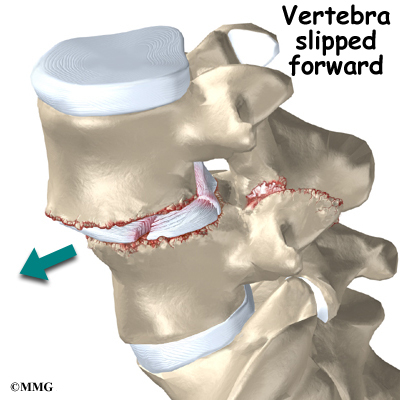
    Lumbar Spondylolisthesis: Usually involves slippage of the fifth lumbar vertebra over the top of the sacrum
    Dear CT Spine and Disc Center, I have Spinal Stenosis and Spondylolisthesis. I have worked with a Chiropractor, done physical therapy and just had my 2nd epideral steroid injection on Tuesday, next step is surgery. Would this DRX program be able to assist me? - Dorie

    Dear Dorie, You may be a candidate. As long as the Spondylolisthesis is stable you should be fine. Typically we determine this with a flexion and an extension x-ray (Basically take a picture of your back, then one with you bent forward and one with you bent back). This will show us if it's stable or unstable. An unstable spondylolisthesis will slide quite a bit upon body movement.

    If it is unstable, there is no sense in trying to heal it with decompression because the disc may "slip out" again.

    The good news is that most Spondylolisthesis' we see are because of degeneration and are stable. If this is the case the spinal decompression may be able to help.

    The best thing to do would be to schedule a consultation with Dr Bellinger. Let us know where you may have had xrays or MRI's so we can request those reports. You can call us at 860-633-8756

    CT Spine and Disc Center is located in central Connecticut- Specializing in patients who suffer from sciatica, disc degeneration, bulging disc or herniated disc in the lumbar spine. Call us at 860-633-8756 to see if you are a candidate for non surgical spinal decompression

    Image Source: www.eorthopod.com

    Additional Reading Resources:

    Friday, February 29, 2008

    "Why Does Every Dr I See Tell me There's Nothing Wrong When I Have Major Back & Leg Pain "

    "I've been through multiple tests - XRays, MRI's of my entire spine, blood work, nerve tests and more".

    "Every doctor says there's nothing wrong but I have severe back pain and leg pain too. What could it be and what do I do? I can't deal with this pain any longer!"

    Sound familiar?...Many times there can be a low back disc issue creating the pain or problem that doesn't get properly diagnosed and caught!

    I see many patients who come in with degeneration in the spine and alot of lower back pain or leg symptoms.

    Degeneration is sometimes enough to create major presssure on the nerves which gives you back pain, leg pain, tingling and numbness, or something worse.


    When the disc degenerates it will flatten and bulge. This flattening will leave less room for the nerve to exit off of the spinal cord and communicate to the low back, hips, legs, and the muscles in these region.

    Degeneration may not always be taken seriously because over time most people will get some degeneration or arthritis as they get older!...When, in fact, depending where that degeneration is exactly, and what nerves it puts pressure on, can determine what symptoms may occur - back pain, muscle stiffness or spasm, leg or foot pain, etc...

    So remember, if you have pain then it's not normal and most likely may get worse! You may be a candidate for non-surgical spinal decompression.Call CT Spine and Disc Center to see if you will be a candidate for our treatment at 860-633-8756

    Tuesday, September 25, 2007

    A Valuable tool in diagnosing Lumbar Disc Herniations: MRI's

    One of the ways to determine if a patient has a disc herniation is with an x-ray- specifically a lumbar MRI will pin point exactly the nerve root responsible for the pain down your leg. MRI stands for Magnetic Resonance Imaging and it a very telling tool when it comes to looking at disc herniations. When looking at a lumbar spine MRI we can assess if the intervertebral disk spaces are of normal height, and the disks do not project past the posterior surface of the vertebral bodies in any segment. Here is a normal Lumbar MRI:


    The patient lies inside a large, cylinder-shaped magnet. Radio waves 10,000 to 30,000 times stronger than the magnetic field of the earth are then sent through the body. This affects the body's atoms, forcing the nuclei into a different position. As they move back into place they send out radio waves of their own. The scanner picks up these signals and a computer turns them into a picture. These pictures are based on the location and strength of the incoming signals.

    Our body consists mainly of water, and water contains hydrogen atoms. For this reason, the nucleus of the hydrogen atom is often used to create an MRI scan in the manner described above

    History Of MRI
    It was on July 3, 1977 that the first MRI exam was ever performed on a human being.

    It took almost five hours to produce one image. The images were, by today's standards, quite ugly. Dr. Raymond Damadian, a physician and scientist, along with colleagues Dr. Larry Minkoff and Dr. Michael Goldsmith, labored tirelessly for seven long years to reach this point. They named their original machine "Indomitable" to capture the spirit of their struggle to do what many said could not be done.

    This machine is now in the Smithsonian Institution. As late as 1982, there were but a handful of MRI scanners in the entire United States. Today there are thousands. We can image in seconds what used to take hours.

    LinkWithin

    Blog Widget by LinkWithin