Showing posts with label muscle spasm treatment. Show all posts

Thursday, September 16, 2010

Chiropractic Helps Muscle Tightness and Muscle Spasm


Everything in the spine connects- muscles have tendons that connect to bone, bones are connected by joints or ligaments, one part of the body connects to the next… It makes complete sense that if you align the spine and or mobilize an area that was supposed to move that wasn’t, that the body will start working better.

If everything is in its proper alignment or position it allows all the surrounding structures to do the same. Let’s take an example: Let’s say on side of the pelvis is shifted, you may even notice it in the mirror in your posture. Then, chances are that your sacrum or lumbosacral junction on that side becomes irritated or restricted. This also means that the ligaments and tendons in the area are compromised leading to problems in your gluteus muscles, low back muscles and even hip musculature.

Let’s take a step back- what was the lumbosacral junction? This is where your lumbar spine meets the sacrum. Just off to the sides of this joint are your sacroiliac joints (where the sacrum joins one side of the pelvis or ilium). You already see all the connections being made just in the lower low back. This area is also one that is rich in nerve supply.

You can obviously come to the conclusion that freeing up a nerve will get things feeling better. Muscle tightness and spasm is the same. Essentially the muscles are controlled by the nerves. If there is nerve pressure then those muscles innervated by that nerve or nerves will get some problems. It’s like kinking a garden hose, if that flow to that muscle is inhibited it won’t work at 100%.

So you then can understand how relieving nerve pressure will help. This is exactly what your chiropractor does. Now bone on nerve makes sense but typically it’s inflammation that irritates the nerve; whether it’s inflammation on the nerve or the nerve itself gets inflamed. So, really what happens is that when we mobilize a restricted area or align the back, inflammation is then able to dissipate and communication is restored allowing all parts of the body to function normally again – all the way down to the cellular level. Doing this gets rid of muscle spasm and tightness.


The Glastonbury Chiropractor is located in central Connecticut- CT Spine and Disc Center specializes in patients who suffer from sciatica, disc degeneration, bulging disc or herniated disc in the lumbar spine. Call our chiropractic office at 860-633-8756 to schedule an appointment and to see if you are a candidate for non surgical spinal decompressionAdditional Reading Resources:


Tuesday, September 14, 2010

What Specific Muscle Tightness do 90% of my Back Pain Patients Have?

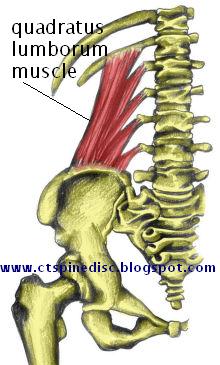
quadratus lumborum is one muscle is one muscle that can be the cause of lower back painMost have some tightness or spasm or maybe trigger points in the lower back musculature, but everyone is a little different. It might be tightness in the quadratrus lumborum, spasm of the paraspinals or knots in the gluteus medius.

As far as tightness goes for one specific muscle, the answer is hamstrings. Always keep in mind that the whole body works together and everything attaches. The calves attach to the hamstrings, the hamstring muscles to the gluteus muscles, and the gluts to the lower back.


Keeping the leg muscles loose is extremely helpful in restoring the low back’s function. The hamstrings are one of the biggest and most powerful muscles in the body. Stretching them on a regular basis will help your back. And now you know; if you are suffering from back pain, chances are you have some tightness in your hamstrings.


Picture Source: Meet the quadratus lumborum

Additional Reading Resources

Friday, September 10, 2010

The Benefit of Electrotherapy used in Conjunction with the Chiropractic Adjustment

At CT Spine and Disc Center, we use other therapies in addition to the chiropractic adjustment. Such therapies include vibration, moist heat, cold therapy and electrotherapy. Electrotherapy is often used to relieve pain and relax muscle spasms. Often times, the electrotherapy is used in conjunction with a hot or a cold pack.

Electrotherapy can be used in the “interferential” or “premodulated” form- both of which treat pain.

For muscle spasm reduction, a medium frequency wave length called “Russian stim” is often used.

Using electrotherapy involves applying pulsating electric currents to certain areas of the body, such as the low back, mid back, or neck via electrodes. This process elicits responses from nerves which are involved in pain sensation and muscle contraction information. The stimulation of sensory fibers will help block pain while stimulation of motor fibers will produce pulsatile contractions of the muscle groups innervated by the nerves being stimulated.

Electrotherapy is often used for:

  1. Chronic pain that does not go away
  2. acute pain
  3. relaxation of muscles
  4. increase of blood flow to the treatment area
  5. muscle re-education
  6. increasing range of motion
  7. prevention of atrophy of muscles

Electrotherapy can be used to relieve pain and muscle spasm without increasing inflammation or swelling. Also, no heat is produced when using electrotherapy.


The Glastonbury Chiropractor is located in central Connecticut- CT Spine and Disc Center specializes in patients who suffer from sciatica, disc degeneration, bulging disc or herniated disc in the lumbar spine. Call our chiropractic office at 860-633-8756 to schedule an appointment and to see if you are a candidate for non surgical spinal decompressionAdditional Reading Resources:


LinkWithin

Blog Widget by LinkWithin